
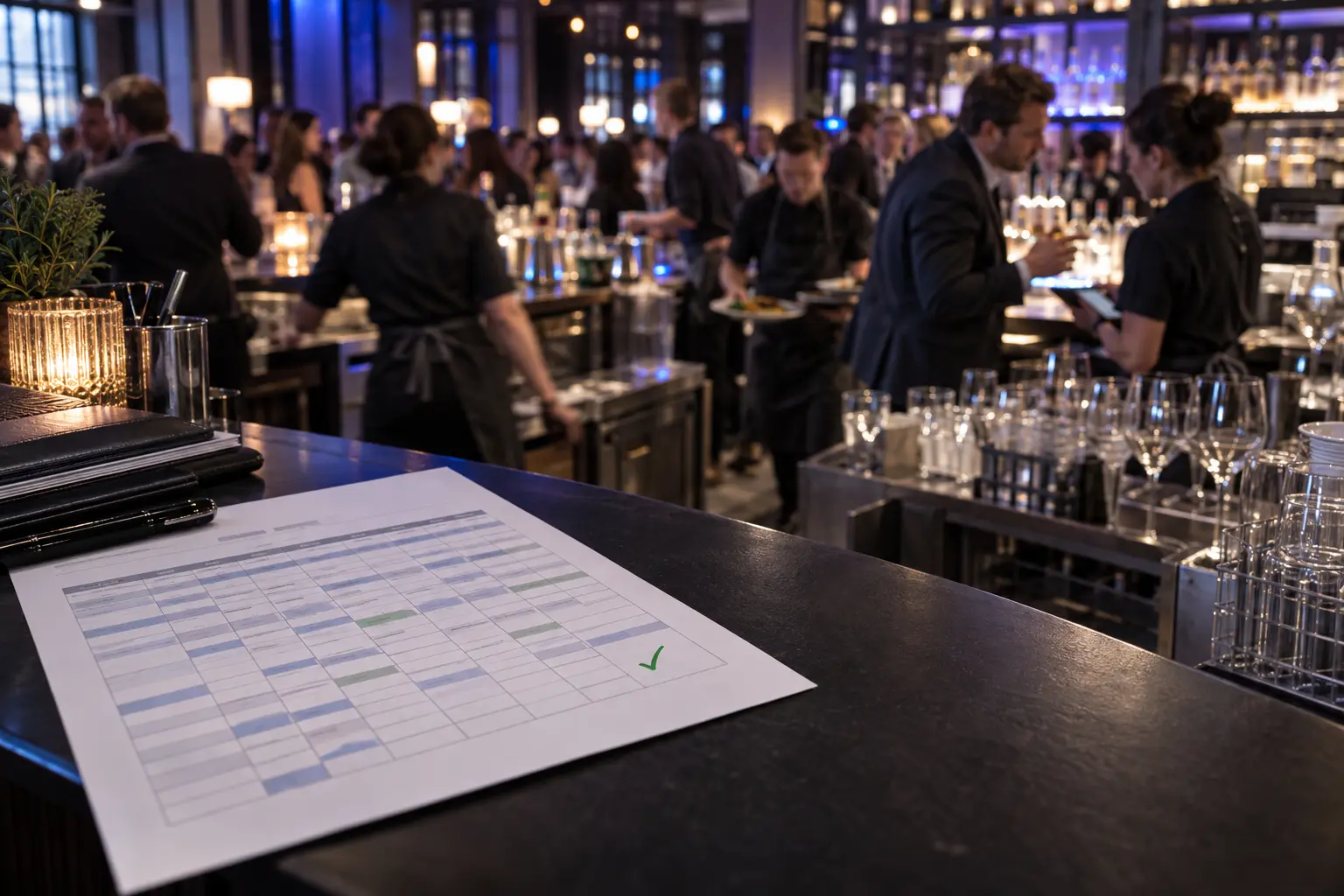
You can obey every employment rule, hit your wage budget and still write an absolutely terrible rota.
That sounds obvious when you say it out loud, particularly to anyone who has spent a Saturday night running a busy hospitality venue. Yet an enormous amount of rota management still revolves around two measures: are we compliant, and are we on budget?
Both matter. Increasingly so.
The National Living Wage rose to £12.71 in April 2026, another 4.1% increase at a time when hospitality businesses were hardly drowning in spare margin. A Q2 industry survey found that 23% of respondents were operating at a loss and one in six believed their business was at risk of failure within the following 12 months. Employment legislation is changing too, with new rights around guaranteed hours, shift notice and short-notice changes expected in 2027 once the remaining implementation details are settled.
So of course operators are scrutinising labour. They should be.
The problem starts when legal becomes a synonym for good, or when cheap becomes a synonym for efficient.
Neither is true.
Compliance is the starting line, not the finish line
UK working-time rules create some important boundaries around a rota. Adult workers are generally entitled to 11 hours of daily rest, a 20-minute uninterrupted break when working more than six hours and appropriate weekly rest. The famous 48-hour limit is slightly more nuanced than it is often presented in hospitality conversations, because it normally applies as an average over a 17-week reference period, and adult workers can opt out in certain circumstances.
Those rules matter, but they are mostly concerned with establishing minimum protections. They cannot tell you whether your Saturday night is going to work.
It is a little like VAR. VAR can spend three minutes establishing whether someone's shoulder was six millimetres offside. It cannot tell you whether the team is playing well.
A rota can give everyone their required rest and still put your weakest bartender on the busiest dispense station. It can sit comfortably within working-time limits while your only experienced closing manager is inexplicably scheduled on the open. It can technically meet every contractual obligation while giving you a management team that looks reassuringly chunky at 3pm and mysteriously disappears just as the building fills up at 8pm.
We've seen versions of all of these in businesses we've worked in. Not because the manager writing the rota was incompetent, but because hospitality rotas contain an extraordinary number of competing decisions. You're thinking about wages, availability, holidays, contracts, skills, events, expected sales, who closed last night, who's opening tomorrow, who works well together, who absolutely does not, and whether the person you have optimistically labelled a "cocktail bartender" can actually make twelve drinks simultaneously while someone asks them where the toilets are.
The law cannot make those judgements for you. A wage budget cannot either.
Eight people is not necessarily eight people's worth of coverage
This is where simplistic rota planning starts to break down.
Imagine the forecast says you need eight people on the floor between 7pm and 10pm, so you schedule eight. On paper, you've hit the number perfectly.
Now look at the eight people.
Who can run a section properly? Who knows the bookings? Who can take control when a table has been waiting too long? Who can close? Is there a keyholder? Have you accidentally scheduled three brand-new starters together? If the supervisor gets pulled into a complaint for twenty minutes, does the rest of the floor continue functioning or does everything quietly catch fire?
In high-volume venues we've worked in, the difference between six well-deployed people and eight badly-deployed people can be enormous. The same is true behind a bar. Four bartenders is not really four bartenders if only one is confident on dispense, one is still training and another needs a manager every time something unusual happens on the till.
Hospitality does not really operate on headcount. It operates on capability at a particular moment.
That becomes even more important in venues affected by events, sport and entertainment. A perfectly sensible staffing level at 6:45pm can be completely wrong twenty minutes later when a football match reaches full-time. A concert finishing nearby, a sudden change in weather, or an unexpectedly strong walk-in trade can move demand faster than a weekly sales forecast ever will.
Anyone who has run a destination venue knows the strange experience of looking at a rota that seemed perfectly reasonable on Tuesday and wondering, by 9:15pm on Saturday, what idiot wrote it.
Occasionally that idiot is you.
That's hospitality.
Being under budget can be very expensive
The most dangerous rota decisions are often the ones that make the spreadsheet look better.
Labour percentages are visible. They get discussed on Monday calls, appear on weekly reports, and if they turn red somebody senior wants an explanation. Site managers learn quickly that removing hours produces an immediate and measurable improvement, and gives them some precious extra moments out of the glare of their Area Manager.
Take a bartender off between 8pm and 11pm and scheduled labour falls. Excellent. You have saved three hours.
What is harder to measure is what happens next.
The remaining bartenders become three-deep. Glasses stop coming back quickly enough. Someone gets pulled off table service to support dispense. Drinks start taking fifteen minutes. Guests skip the second round. A supervisor who should be running the room spends most of the evening carrying glassware and apologising. The manager on duty gets dragged into the operation instead of managing it.
You saved the wage. You may have lost substantially more in revenue.
We have worked in businesses doing six-figure weekly sales where a tiny downward percentage movement in labour understandably attracted serious scrutiny. In operations of that scale, wage control is not optional. Small inefficiencies repeated across fifty or eighty employees become very expensive, very quickly.
But the scale cuts both ways. On a busy night, the cost of removing the wrong £40 of labour can comfortably exceed the £40 you saved.
That is why the cheapest rota and the most profitable rota are not necessarily the same rota.
There is a point where reducing labour stops removing waste and starts removing capacity. The difficult part of hospitality management has never been understanding that distinction in theory. It is identifying exactly where that line sits on Thursday lunch, Friday evening and Saturday at 10pm, then deploying people accordingly.
The rota tells your team what you value
There is another cost that rarely appears in the weekly wage percentage.
People read rotas much more closely than managers sometimes realise.
They notice who always gets Saturdays off. They notice who keeps getting the best shifts and who gets sent home first. They know when somebody with fewer responsibilities is consistently getting more hours. They notice when the same reliable supervisor closes Friday, works Saturday and comes back Sunday because they're "the only person we can trust".
Most importantly, people notice when the agreement they thought they had with the business quietly changes.
Give a waitress roughly 30 hours every week for months and then suddenly give them 14 without a conversation, and you may see a labour saving. They see their rent and livelihood suddenly in jeopardy.
This is partly a welfare issue, but treating it only as one undersells its commercial importance. A rota that repeatedly exhausts your strongest employees, starves good people of hours or creates obvious favouritism will eventually appear somewhere else in the P&L. Recruitment costs increase. Training starts again. Management spends time interviewing instead of operating. Experience disappears from the floor. Service becomes less consistent.
The cost has not disappeared. It has simply moved to another line of the P&L.
The direction of employment law is moving towards greater predictability too. The Employment Rights Act 2025 provides the framework for rights covering guaranteed hours, reasonable notice of shifts and payments where qualifying shifts are cancelled, moved or curtailed at short notice. Those measures have not yet taken effect and important details are still being worked through, but they are expected to be introduced during 2027.
Good operators should not need legislation to tell them that repeatedly changing someone's life at the last minute is poor management. The legislation is interesting because it suggests the law is beginning to formalise something good hospitality leaders have understood for years.
Predictability has value.
A good rota has to survive four different tests
We've found it useful to think about a hospitality rota through four lenses.
The Law (Legislation)
Is it compliant? Are you respecting rest, working-time requirements, contractual obligations and the other responsibilities that come with employing people?
This is the non-negotiable layer. But passing it tells you only that you have cleared the minimum standard.
The Floor (Operations)
Will this team actually run the business you've forecast?
Not just how many people are present, but who they are, what they can do and when they're there. Does the deployment reflect the rhythm of the venue rather than simply its opening hours?
The Score (Margins)
Is labour being deployed where it has the greatest commercial and financial value?
That means challenging obvious overstaffing, but it also means recognising that a lean-looking rota can become very expensive when it damages throughput, service or sales. Proper labour control is about return on deployment, not simply reducing the number at the bottom of a spreadsheet.
The Core (People)
Can this rota be repeated without gradually destroying the team that delivers it?
Are hours broadly fair? Are contractual expectations being respected? Are the same dependable people carrying the difficult shifts every week? Are you creating the conditions for your strongest employees to stay?
The difficult part is that these four things regularly pull against each other.
Removing an hourly paid supervisor shift may improve the wage percentage but leave them under their expected hours and weaken leadership coverage. Adding another bartender might technically push you above your normal staffing level but be completely justified because England are playing and you know what happens to the bar at half-time. Giving your best supervisor another full week of weekend closes may solve tonight's problem beautifully while contributing to a resignation three months from now.
None of those decisions make sense when viewed through a single metric.
That is why good rota management is judgement.
There is a difference between writing a rota and interrogating one
Most experienced operators develop a sixth sense for this eventually. You stare at a rota and something just feels wrong.
Saturday looks thin.
There are too many managers on Tuesday.
That new starter has somehow ended up on four closes.
The kitchen looks fine by total hours but inexplicably weak during Friday peak.
Someone you normally see everywhere has barely been scheduled at all.
The problem is that this instinct usually arrives after years of making rotas, running services, and occasionally getting things horrifically wrong. It also sits in one person's head. When that GM leaves, much of that accumulated judgement leaves with them.
The better question for hospitality is whether some of that thinking can become systematic and codified.
I'm not saying software should run the venue. It shouldn't.
But a manager shouldn't need to simultaneously remember forty employees' hours, tomorrow's opening team, every availability constraint, every service par and whether Dave has now worked three full weekends in a row while trying to finish the rota before pre-shift.
That is an unreasonable amount of operational context to hold in one person's head.
If this article has made you wonder how much of your rota process relies on someone simply noticing that something looks wrong, that's exactly what our free Rota Reality Check is designed to explore.
It looks beyond the finished rota at the wider process around it: how much rework happens, whether deployment reflects the floor, how labour decisions affect margin, how your people experience the schedule, what visibility exists across multiple venues, and what happens when the final rota needs to make its way into payroll.
The best rota is not the one with the fewest warnings
Hospitality is operating in an unforgiving environment. Wage costs are high, significant numbers of businesses are still losing money and employment requirements are becoming more sophisticated. There is every reason for operators to get more forensic about scheduling.
But forensic does not mean blindly cutting.
A genuinely good rota protects the business without punishing the team. It controls labour without strangling revenue. It gives managers enough structure to make better decisions without pretending that a Saturday night can be reduced to an equation.
Most importantly, it works when the doors open.
Because nobody standing for 15 minutes four-deep at the bar cares that the wage percentage looked fantastic against forecast.
A legal rota can still be a bad rota.
And now more than ever, simply being legal is nowhere near good enough.
General information only: Employment law changes over time and individual circumstances vary. Check current official guidance or take professional advice before relying on any legal position.