
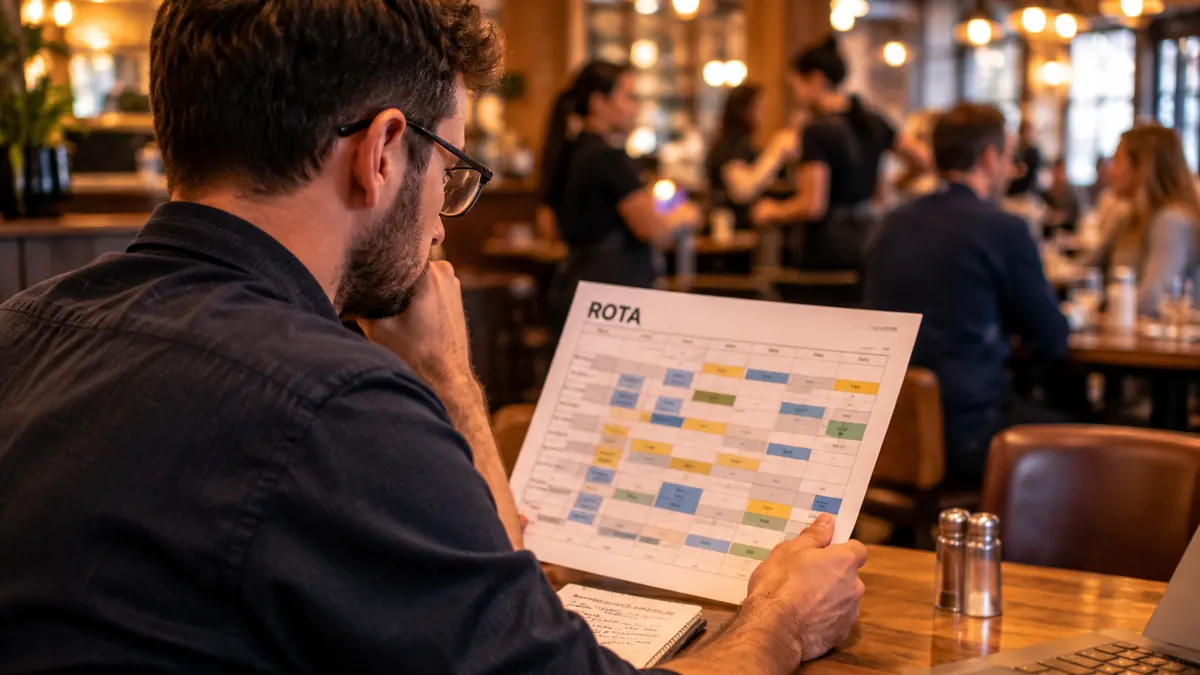
The bar manager sends their rota on Monday. On time, for once.
Wages are in line. The right people are on the late shifts. There are two strong closers. The bar manager is reasonably pleased with themselves and, having survived last Saturday, deserves a moment of optimism.
The floor manager has done the same. The sections are covered, contracts are respected and the weekend forecast looks manageable. Kitchen has its prep and service team organised. Everybody has built a rota that makes sense for their department.
The GM checks the totals, asks a couple of questions, signs off the week and sends it upstairs.
Then Friday arrives.
By 8pm, floor staff are taking drink orders faster than the bar can produce them. Kitchen is getting food out, but plates are sitting at the pass because the runners are helping on the terrace. Someone needs to deal with a guest complaint, and the duty manager is behind the bar trying to rescue dispense.
There are plenty of people working.
Each department's rota can still be defended.
The venue, unfortunately, cannot.
Three good departmental rotas do not automatically add up to one good operation.
Guests don't recognise your departmental boundaries
The distinction is painfully obvious from the customer's side of the business.
A guest arrives, gets seated, orders a drink, chooses food, asks a question, has another drink and eventually pays. They think of this as one experience. They have little interest in whether a delay belongs to the floor manager, the bar manager or the kitchen.
Yet behind the scenes, hospitality businesses often divide that experience into separate staffing plans.
Bar schedules enough people to serve the bar's expected volume. Floor schedules enough people to run its sections. Kitchen schedules enough people to prepare the food. Each manager has a wage allocation and a set of responsibilities they understand.
That division is sensible. A good head chef knows their kitchen better than a GM who spends most of the week on the floor. A strong bar manager knows which bartender can lead dispense and who still needs support with a difficult close. Department ownership creates expertise and accountability.
The trouble starts when each rota is assessed as though the departments operate independently.
In a real service, the pressure travels.
A strong floor team can generate orders the bar cannot fulfil. A fast kitchen can create a backlog at the pass. A bartender pulled into restocking affects how quickly servers can turn tables. A supervisor carrying an extra section has less attention available when another department needs help.
Every one of those issues crosses a line on the organisation chart.
None of the guests care where that line is.
The busiest hour is where the rotas meet
Imagine a restaurant with a bar, a sizeable dining room and a kitchen working towards a Friday evening peak.
Floor has arranged four strong sections and a host. The schedule looks appropriate for the covers expected. Bar has two bartenders for the evening, which would ordinarily be enough for its own walk-in demand. Kitchen has enough chefs for the forecast food orders.
Then a large table arrives slightly early and a nearby event finishes. The dining room fills quickly, with guests ordering drinks before food. The bar's workload now reflects demand from two sources, but its rota was built around only one.
The floor team is doing exactly what it should. Guests are being seated and orders are being taken.
The bar team is also working hard. It simply cannot produce everything at the pace that the combined room is asking of it.
Food begins leaving the kitchen while the floor is tied up chasing drinks. The runner disappears to help clear a busy section. The chef at the pass is now waiting for somebody to take plates, which slows the kitchen behind them.
At that point the problem is spreading backwards and forwards through the building. Adding another server may make it worse by producing more orders. Adding another chef won't move the plates. The right intervention might be a bar support period, a protected runner or different timing for the existing team.
But if every rota was written and approved on its own terms, who was supposed to spot that?
That question belongs to the person responsible for the whole operation.
The GM's job is to check the seams
Department managers should absolutely build their own rotas where they have the skill and authority to do so.
There is little virtue in a GM dictating every bartender start time and kitchen prep shift from an office. It removes ownership and often produces weaker decisions. The department manager knows the personalities, capabilities and daily demands in their area.
What the GM must do is review what happens when the separate plans are combined.
Not simply add all the wages together. Actually imagine running the shift.
When the dining room fills at 7:30pm, can the bar absorb the order flow?
If kitchen is expected to produce a large number of plates at 8pm, who gets them to tables?
Are the floor and bar both planning breaks in the same window?
Is the supervisor covering a section also being counted as management backup for the bar?
Has the bar manager scheduled the strongest bartender to finish at the exact time the entertainment ends and the whole room starts ordering?
Has the duty manager been allocated operational jobs that mean nobody will be free to manage?
None of these questions requires a huge central approval process. They require a shared picture of the same Friday.
That is the difference between signing off three rotas and signing off a venue.
Departmental targets can reward the wrong decisions
The problem becomes more interesting when performance reporting enters the picture.
Suppose each manager has a separate wage target.
The bar manager can improve their result by removing one support shift. Floor can improve its result by cutting a runner. Kitchen can protect its percentage by scheduling fewer hours before service.
The three wage lines improve. All three managers have responded to the financial pressure in front of them.
Now look at what the business has bought.
The barback duties move onto the bartenders. Food running falls to the servers. Prep gets squeezed into the opening of service. Management spends more time rescuing bottlenecks, and guest service becomes slower despite the apparently sensible departmental savings.
Nobody has been reckless. In fact, the incentives may have encouraged each manager to make exactly the decision they were rewarded for.
The cost sits between their departments, where the reporting rarely assigns it to anyone.
This is why departmental labour targets should be part of a wider commercial review. The venue still needs to make money as one business.
A pound removed from the bar's labour line is not automatically a pound of operating benefit if it prevents the floor from selling another round. Equally, a floor runner whose workload is mostly empty during a quiet period may be a genuine opportunity to move or remove hours.
The answer depends on what the shared work requires.
We've explored the commercial difference in Cutting Labour Is Not the Same as Controlling Labour. Departmental rotas make that distinction harder to see because costs and benefits often appear in different managers' reports.
The shared roles are where assumptions multiply
Most large venues have people who help across departments.
A barback supports multiple stations. A runner supports kitchen and floor. A supervisor can take a section, cover a break, deal with a guest and occasionally jump on bar. A duty manager should understand the whole building well enough to move resources where demand is strongest.
Those are strengths, particularly in complicated hospitality environments.
But flexibility has limits.
A runner cannot simultaneously be on the terrace and at the kitchen pass. A supervisor helping two departments still has one pair of hands. A duty manager whose emergency contribution has become a permanent bar station is no longer available to do most of the work for which the business scheduled a duty manager.
The risk is subtle when everyone submits a separate rota.
Floor has written 'runner cover' in its plan. Kitchen has assumed the same runner will be available to collect plates. Bar expects a supervisor to take a break cover period. The supervisor is already being treated as an independent floor section.
Each department has a reasonable story about where support will come from.
The stories are all about the same people.
We covered the distinction between staff count and usable capacity in Headcount Is Not Coverage. The cross-department version is especially dangerous because nobody necessarily sees the double-counting until service is underway.
The way to test it is embarrassingly simple: ask what the person is actually doing at a particular time, and which job will be left uncovered when they move.
If the answer is 'they'll work it out', the shift may already be relying on them to solve a staffing problem that hasn't been acknowledged.
The timing of the handoff can matter more than the number of people
Two departments can both have enough total hours and still hand work to each other at the wrong time.
Consider a floor team beginning to take its peak breaks at 6pm while the bar receives its first wave of after-work customers. A bar support shift begins at 7pm, an hour after the order pressure starts. Kitchen has moved its prep time later to save a quiet hour, then spends part of service finishing work that should already have been done.
Nothing in those departmental totals necessarily looks excessive or thin.
The timings don't work together.
Sometimes the improvement is as small as moving an existing shift by thirty minutes. Perhaps the runner starts earlier for the booking, the bar support person overlaps with floor's busiest handover, or a supervisor's break moves so the duty manager is free through the event let-out.
You haven't added a person. You have changed which work the existing labour can cover at the moment it is needed.
A GM who looks only at weekly wage percentages can miss that completely.
A GM who understands how the sections, stations, kitchen and management duties interact can often improve service without increasing the wage budget at all.
One accountable person does not mean one person does all the work
There is a danger in giving the GM ultimate responsibility for the combined rota.
It can become an excuse for everybody else to stop thinking beyond their own department.
The bar manager submits a rota and says the GM approved it. Floor complains that kitchen didn't tell them about a shift change. Kitchen assumes the manager on duty will find a runner if the pass gets busy. The GM becomes the owner of every gap nobody else wanted to own.
That is not departmental accountability. It is management by shrug.
A better arrangement is clearer.
Department heads own the quality of their team's plan. They should know what their staff can do, where their labour is being spent, how the department's service will run and what they expect from other areas.
The GM owns the integrated view. They challenge the handoffs, timing, shared roles, combined cost and overall trading assumptions.
Operations leadership owns the standards and challenges the commercial reasoning without trying to prescribe every station in every venue.
The exact job titles vary, but the principle travels well. Someone has to inspect the whole week, and that person needs enough information to do it properly.
This also makes it easier for a new GM or department head to take over. Instead of inheriting three schedules with several undocumented arrangements between them, they inherit a description of how the building normally works.
A ten-minute review can prevent a three-hour rescue
You don't need to run an entire mock service every Tuesday before approving a rota.
Choose the two hours in which the venue is most likely to be stretched. On a sports-led bar it might be full-time and the period immediately afterwards. In a restaurant it may be dinner bookings and the food-and-drinks overlap. In a food hall it could be the lunch wave across multiple levels and several service points.
Put the department rotas beside each other.
Look at the moment guests arrive, the moment orders begin hitting bar and kitchen, the point when food and drinks need moving, the break windows and the role of duty management.
Ask every department head what they need from the others, and what they are assuming will be available.
Then ask one more question.
What happens if all three departments get busy at exactly the same time?
There may be a clear answer. Perhaps your runner plan is strong, the bar has flexible overlap and management is genuinely free to coordinate. Excellent. You can publish with confidence.
If the answer is that the same supervisor will cover breaks, carry food, support the bar and deal with guest issues, at least you have discovered the problem while changes are still easy.
You can move the existing labour, reconsider the shared role or buy a small amount of targeted cover if the commercial case supports it.
The useful thing is that the decision is now deliberate.
The venue runs one rota
Departmental ownership works. It teaches managers to understand labour, develop their teams and take responsibility for the quality of service in their area.
Good GMs should want more of that, not less.
But guests experience one operation. Sales, service delays, labour costs and team pressure travel across departmental boundaries whether the management structure acknowledges it or not.
You can have a technically sound bar rota, a responsible floor rota and a carefully built kitchen rota, and still send everyone into a Friday that has never been planned as one shift.
The final GM check should therefore go beyond totals and individual departments.
Look at the handoffs. Look at the shared people. Look at the peak hour. Look at who will have enough capacity to manage when the whole building needs attention.
If those things work, the three departmental rotas have a chance of working together.
A department manager writes a rota for their team. Somebody still has to write the Friday the venue will actually experience.