
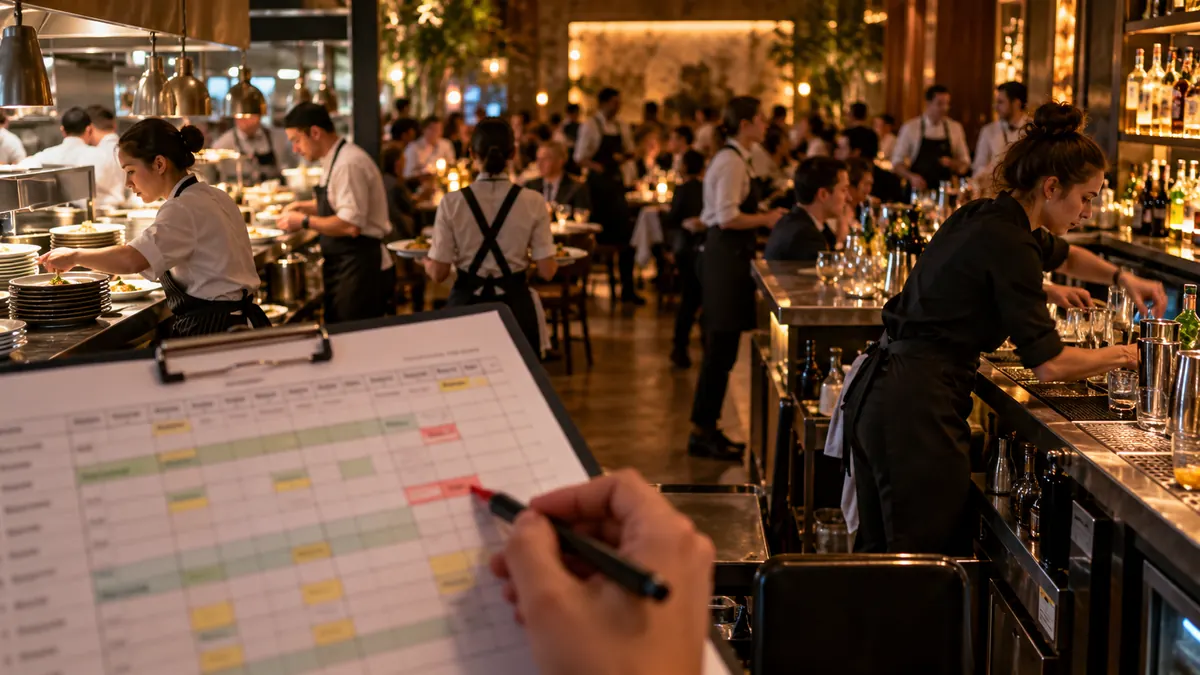
It's 11pm. The bar is closed. The last few customers have finally been persuaded that the music ending was not an invitation to negotiate another round.
According to the rota, four people finish at eleven.
According to the building, nobody is going anywhere.
There's a mountain of glassware, the fridges need restocking, the bar mats are still wet, somebody has to count the cash, and a surprisingly large number of tables have somehow ended up nowhere near their original homes. The duty manager is dealing with an incident that should have taken five minutes and has now developed into a conversation about CCTV.
At 11:35, the closing team is still there.
At 11:50, somebody asks whether they should clock out.
At twelve, the manager is writing notes about why wage percentage finished over.
Perhaps the close was genuinely unusual. Maybe a big booking stayed late, an incident swallowed management time or the glasswash stopped cooperating. Every venue has nights like those.
But if roughly the same thing happens every Friday, there is another possibility.
The rota didn't schedule the work that was always going to happen.
Closing time is a trading decision, not a payroll calculation
Venue opening hours are useful when building a rota. They tell you when customers can arrive, when service takes place and when the business is expected to close.
They don't tell you how long the jobs around that service take.
If the bar closes at 11pm, there's a perfectly reasonable chance the last sale happens at 10:58. It may be a very large round. Those drinks still need making, the guest still needs serving and the glassware still needs returning. The tills and the building do not magically put themselves to bed at the licensing deadline.
Yet the logic of some rotas seems to assume they do.
The opening bartender starts at ten, because the bar opens at ten. The closing bartender finishes at eleven, because the bar closes at eleven. Between those two numbers sits a tidy block of labour that looks wonderfully efficient.
Sometimes it can work, particularly in a small, well-prepared operation with a genuinely light close.
In a high-volume bar, it usually means something else is being assumed.
Perhaps someone will arrive early without it being visible on the rota. Perhaps the manager will finish everything that remains. Perhaps the staff will stay late and the hours will be dealt with at payroll. Or perhaps the work simply won't get finished properly.
Those are very different operating plans.
Only one of them might be written down.
The extra twenty-five minutes adds up quickly
Take an illustrative venue with four hourly paid closers. Each routinely stays twenty-five minutes beyond the scheduled finish. It happens on six nights a week. Their basic wage is £15 an hour, and assume all that additional time is paid.
That is four people × twenty-five minutes × six nights: ten additional employee-hours a week.
At £15, the basic wage cost is £150 a week, or £7,800 across fifty-two weeks, before employer on-costs or any applicable premiums.
There is a trap in that calculation.
It is tempting to call £7,800 a labour saving opportunity. Sometimes it is. Perhaps the closing process is inefficient, work is being repeated or the wrong equipment is forcing a team to stay longer than necessary.
But if those ten hours are genuinely necessary to close the building safely and properly, removing them from the payroll won't remove the work. It will simply move the pressure onto people, standards or the following morning.
The number is valuable because it tells the GM that the published rota is systematically underestimating the operating day. It does not tell the GM whether the correct answer is to schedule later finishes, stagger the close, redesign the process or buy better equipment.
That is the decision worth making.
The work usually arrives in predictable places
Once you look for it, the missing work is rarely particularly mysterious.
A restaurant opens at noon, but the first section needs setting, the terrace needs unlocking and the coffee station needs preparing. The manager spends the first forty minutes helping set up because everyone else starts at twelve.
A busy bar schedules enough bartenders for the expected sales peak. Nobody has protected time for ice, fruit, glassware or the delivery that reliably arrives halfway through lunch. The jobs get done, of course. They just get done by whichever person is easiest to pull out of service.
A kitchen has a perfectly sensible dinner rota until you consider that a large delivery needs checking, dated and put away before prep can really begin. The same chef is being paid to receive stock and simultaneously expected to produce the prep that service depends on.
None of these jobs is optional. Some are small, some can be combined, and some can be completed more efficiently. What makes the rota fragile is the assumption that they take no time simply because they don't produce an immediately visible sale.
This is why a venue can be very well staffed for service and still feel hopelessly behind before the first guest arrives.
The shift starts under pressure it never needed to inherit.
You can have two people assigned to three jobs
Consider a Friday night bar with two bartenders.
One is on the guest-facing station, the other on dispense. The rota looks fine until stock runs low or the glassware stops returning fast enough.
Now somebody has to fetch ice, run clean glasses and refill the fridges. Those tasks need doing. The question is whose capacity you've quietly borrowed to complete them.
If the dispense bartender disappears for ten minutes, the printer keeps producing orders. If the guest-facing bartender leaves the bar, the queue grows. If the manager takes over, the person supposed to coordinate service has temporarily become the most expensive barback in the building.
Sometimes that is absolutely the sensible response. A manager should help when service needs it.
But doing it once because the shift changed shape is very different from building every Friday on the assumption that somebody can handle two jobs at once.
We examined how the number of people scheduled can disguise the actual capacity of a shift in Headcount Is Not Coverage. The missing-work problem is the other side of that argument. You can account for every employee and still fail to account for several hours of necessary work.
There are more demands on people's time than the rota has admitted.
The manager is often the hidden contingency budget
It's worth paying particular attention to jobs that quietly default to management.
Handover, stock checks, incidents, cash, breaks, deliveries, paperwork, guest complaints, recruitment interviews and coaching are all things that can be done around the edges of service, in theory.
An experienced manager gets very good at fitting them into the gaps.
That ability is useful and occasionally dangerous. If the rota only works when the duty manager completes an hour of administration while simultaneously running the floor, the business is buying management time and spending it twice.
One version of the cost appears immediately. An important task goes unfinished or the manager stays late.
Another arrives later. Training gets postponed, the same maintenance issue keeps recurring, stock variances are discovered after the useful time to investigate, or somebody who needed a conversation doesn't get one until the problem becomes a resignation.
Those costs are difficult to attribute neatly to Tuesday's rota.
They still began with a decision about how much time the operation believed it needed.
A supervisor being able to carry a quiet floor section is a strength. A supervisor being expected to manage a busy building, run a section, cover the bar and complete the cash-up at the same time is a staffing model built around wishful thinking.
Not every recurring job needs its own employee
There's a reasonable objection here.
If we give every task its own allocated person, labour will spiral out of control. Hospitality businesses simply cannot afford to put an extra shift against every delivery, cleaning job and handover.
Agreed.
The point of identifying work is to make a decision about it, not to justify an unlimited wage budget.
Some jobs can move to a quieter time. Some should happen before the rush rather than during it. Some can be combined with another role, provided the overlap is genuinely manageable. Some are better handled through a shared runner or barback. Others may disappear if the underlying process improves.
Take a venue whose bartenders spend forty minutes walking to a remote stockroom during peak. You could add labour to cover the trips. Or you could review replenishment quantities, layout and prep so the trips are no longer necessary at that hour.
The best answer might save labour without cutting a single useful service position.
But you only discover that once the work has been acknowledged.
Invisible work prevents honest choices. Visible work can be challenged, timed, moved or redesigned.
The time of the task matters as much as the duration
Two hours of prep are not interchangeable with two hours of closing, even though a weekly labour report sees the same cost.
Likewise, twenty minutes of glass collection at 4pm has a different consequence from twenty minutes at 8:15pm when every drink order is waiting for a glass that exists somewhere on the floor.
This is why simply adding a generic allowance for 'non-service labour' can miss the point.
Where does the task need to happen? Who is qualified? What other responsibilities does that person have during the same period? Can it be interrupted safely? What happens to the guest if the work is delayed?
The answers vary between venues.
A cellar delivery in a neighbourhood pub might reasonably be handled by the opening manager and a bartender before lunch. The same delivery landing during a stadium bar's post-match rush may need a different arrangement. A training conversation can be rescheduled in a quiet period; a cash discrepancy cannot always be left indefinitely without losing the ability to investigate it properly.
Timing turns an apparently small task into a meaningful deployment decision.
It also explains why a rota with slightly more overlap at the right moment can outperform a longer, more expensive schedule that places the labour where there is less useful work to do.
The most revealing document may be the clock-in report
You can learn a lot from a good conversation with the closing team.
You can learn even more when that conversation is tested against the hours actually worked.
Take four comparable Fridays and compare the scheduled finish with the final clock-out. Look at who repeatedly extends and by how much. Ask what work took longer, whether the business was unusually busy and whether those same jobs are appearing next week.
Then do the same at the beginning of the day.
Are people consistently clocking in early to set up? Is the duty manager arriving before their paid shift because somebody needs to unlock and prepare the building? Is a kitchen's advertised prep time realistic? Are employees staying to finish work that management has explicitly asked them to complete?
Treat actual worked time accurately and pay it according to the applicable arrangements. Hiding the time to make the rota look cleaner is neither a labour strategy nor a useful account of what happened.
The objective is to learn where the plan keeps underestimating the operation.
Your Rota Isn't Finished When You Publish It looks at the changes made once the week begins. Here the question is earlier: why did the original plan repeatedly leave necessary work out in the first place?
Build the next rota from the jobs backwards
Try this on one day rather than redesigning the whole week.
Take a Friday. Write down what must happen before doors open, during the quieter periods, through the peak, at handover and after the last guest. Include the jobs everybody relies on but nobody ever describes when they say how many people they need.
Give each substantial task an owner and a plausible window. A window doesn't have to mean a new shift. It might mean moving an existing start thirty minutes earlier, giving a runner a protected delivery period, or making sure the manager is not assigned to a fixed station during handover.
Now test the plan against the busiest hour and the close.
Who is serving guests? Who is supporting the service? Who is dealing with jobs that pull people away? What happens when one of those jobs takes longer than expected?
Be honest about whether the plan is affordable. Then decide which work can be redesigned before spending more labour.
If you want to put numbers against the effect, the free wage percentage calculator can help compare the cost of different options. It cannot tell you whether a twenty-minute replenishment task should move to 5pm or whether the close needs another person. That still requires somebody who knows the building.
Give the work a place before somebody has to rescue it
The most expensive labour problem is not always an obviously overstaffed afternoon or a busy shift with too few people.
Sometimes it is a collection of necessary tasks that management has never properly given time to complete.
Everyone knows they happen. Everyone expects them to happen. The rota simply assumes they'll squeeze in somewhere.
When the week goes well, capable people absorb those assumptions and the operation survives. When it goes badly, the cost appears in overtime, unfinished jobs, tired managers, delays and the unpleasant surprise that comes when payroll bears little resemblance to what was published.
A realistic rota doesn't need a separate employee for every task.
It needs an honest account of the work that actually makes the venue run.
If the job happens every week, it deserves a place in the plan, even when it doesn't deserve another shift.