
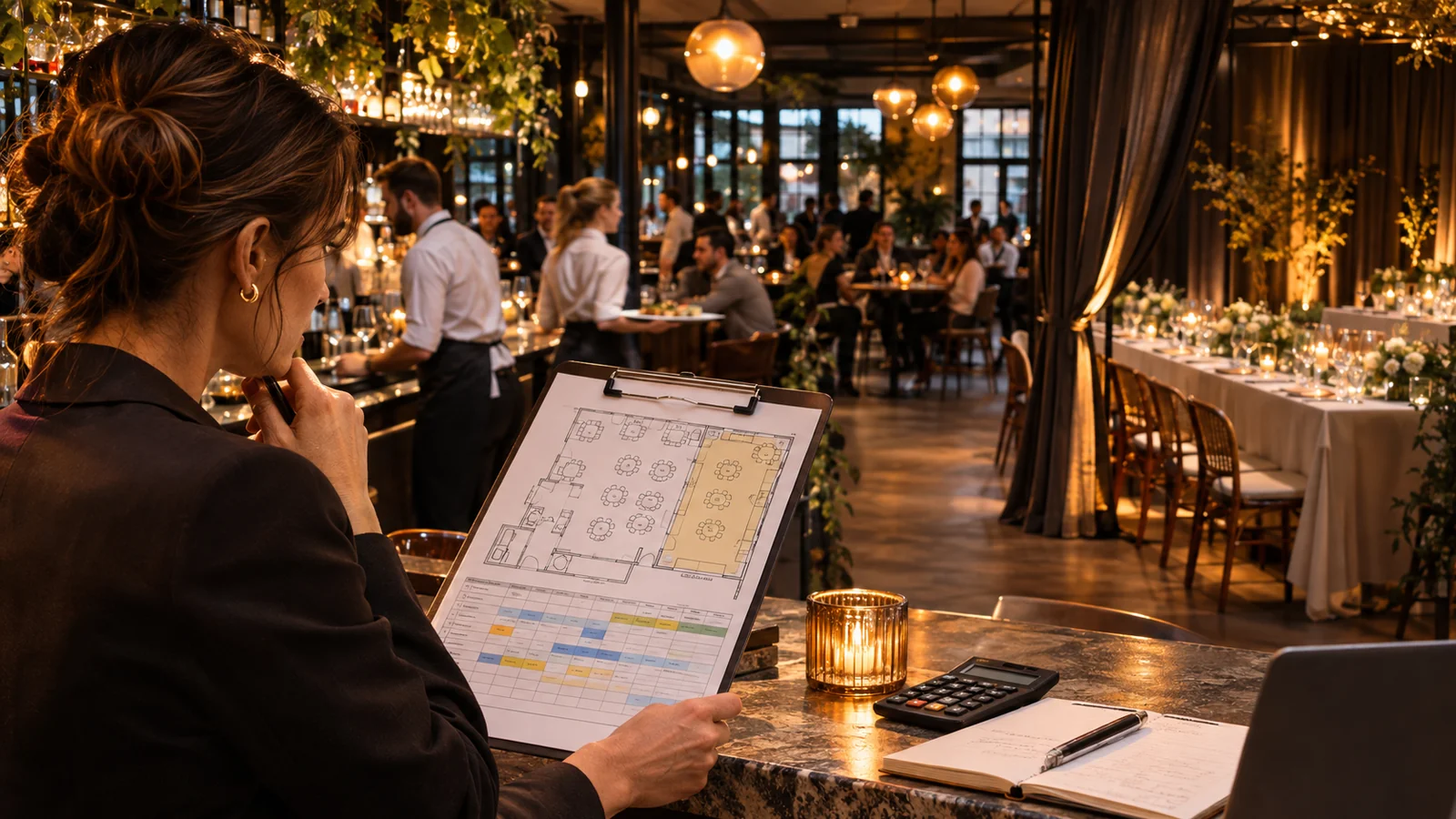
The events team has good news. A company wants to spend £5,000 on a Saturday evening private hire.
It's a proper booking, with a minimum spend and enough notice to plan. The sales forecast improves, the venue looks busy and everyone has a reassuring figure to put in the weekly meeting.
Then the GM asks a slightly awkward question.
What would we have made from that space if we hadn't sold it?
This doesn't make the booking a bad idea. A guaranteed £5,000 can be excellent business, especially in a quiet part of the week. But a busy Saturday is a different proposition. You're not just selling food, drink and a room. You may be giving up an alternative evening of trading.
The answer sits somewhere between the booking contract, the floor plan and the rota.
A full room isn't the same as extra sales
Imagine a restaurant-bar with a space that can be sectioned off for private events.
On a Wednesday, that area might otherwise sit half empty. A decent private hire fills unused capacity. Lovely.
On Saturday between 6pm and 10pm, the same area is normally busy. Closing it to the public could send walk-ins away, reduce available dining covers or remove the tables that would otherwise order drinks all evening.
The booking still records £5,000 in sales. The question is how much of that is genuinely additional to what the venue would probably have done anyway.
This is the accounting idea of opportunity cost: the value of the alternative you give up by choosing something else. ACCA's guidance on relevant costs specifically includes revenues and contribution forgone when assessing a decision.
It's a useful principle for hospitality, where one group booking can occupy a space that would otherwise be earning money through ordinary service.
Put the £5,000 through a proper comparison
Here's a deliberately simplified example for that Saturday event. All figures are illustrative, not industry benchmarks, and all sales are excluding VAT. If the £5,000 quoted to the client includes VAT, convert it to the correct ex-VAT sales figure first. HMRC explains the distinction.
Suppose the event occupies a section of the venue that would otherwise be open to the public. The existing core team remains on the rota either way.
| The private hire | Ex-VAT amount |
|---|---|
| Guaranteed sales | £5,000 |
| Food and drink costs, assumed 30% | -£1,500 |
| Extra event staffing, including employer costs | -£550 |
| Extra security, equipment and setup | -£250 |
| Contribution before shared fixed costs | £2,700 |
That doesn't mean the event has made £2,700 of net profit. The rent still exists. So do the permanent management costs, utilities, subscriptions and the core roster. We're isolating the contribution that changes with this decision.
Now look at the same area's expected public trade during those four hours.
| The alternative Saturday trade | Ex-VAT amount |
|---|---|
| Forecast public sales from that space | £3,900 |
| Food and drink costs, assumed 30% | -£1,170 |
| Additional event-only costs | £0 |
| Contribution before shared fixed costs | £2,730 |
On these assumptions, the booking contributes £30 less than simply keeping the area open.
Not a catastrophe. But a very different decision from looking at a £5,000 booking and assuming you've added £5,000 of value to the evening.
Both scenarios keep the ordinary roster and unchanged overheads out of the comparison. Those costs still exist, but counting them twice wouldn't help decide between the two options. The £550 event staffing is included because it is additional to the people already scheduled.
Change those assumptions and the answer changes, potentially quite dramatically.
The trade you're giving up isn't guaranteed either
That £3,900 of displaced public sales is a forecast, not a reservation in the bank.
Perhaps the weather turns awful. Perhaps the Saturday that looked promising finishes quietly. Perhaps your usual customers simply sit in another part of the venue, so the event displaces very little trade at all.
That's why guaranteed bookings can be commercially attractive even where their expected contribution looks similar to public service. They reduce some demand uncertainty.
If the area would actually have earned only £2,800 in net public sales, at the same assumed 30% product cost, its contribution would have been £1,960. The £2,700 event contribution would then be £740 better.
Likewise, if the event could run with £250 less additional labour without weakening service, it would outperform the original £3,900 public-trade forecast by £220.
The worked example isn't a verdict against private hire. It shows why a GM should ask for a range, not a single optimistic forecast.
And don't automatically treat the entire minimum spend as risk-free. Confirm what is genuinely guaranteed, what deposits or cancellation provisions apply, when payment is due, and which charges sit outside that minimum. A signed enquiry and money in the bank are different things.
The rota can quietly undo the booking margin
The financial discussion often happens before anyone has built the service around the event.
An organiser promises a simple drinks reception. The operation then discovers that the room needs a dedicated host, a bar station, two hours of furniture moves, a late breakdown and someone trained to manage the AV equipment.
The event finishes at ten. The equipment doesn't put itself away at ten.
If the quoted event cost assumed ordinary staffing, those requirements can wipe out an apparently healthy contribution.
Some are unavoidable and absolutely worth paying for. A private hire isn't successful if 120 guests spend the evening waiting for drinks because nobody budgeted enough bartenders to serve them.
The discipline is to make the operating plan part of the booking decision, not an inconvenient surprise after the contract is signed.
Before you price the event, sketch the whole shift: setup, arrivals, welcome drinks, the busiest service window, toilets and cleaning, bar or kitchen production, breakdown and the handover back to normal trading. Then ask which hours are truly extra and which people are already on the rota.
A particularly easy mistake is counting a duty manager as if they're free event labour. If that manager spends three hours acting as the function coordinator, who is running the rest of the venue? If another supervisor is required to cover their normal responsibilities, that cost belongs in the calculation.
This also links to the wider point in The Work Your Rota Pretends Doesn't Exist: the work around service is real work, even when nobody remembered to put it in the staffing plan.
A booking can change what the rest of the venue sells
There's another complication in mixed hospitality venues.
A £5,000 event heavily weighted towards drinks may have a different product margin, production speed and staffing need from a £5,000 seated meal. Plated food, platters, cocktails, packages and self-service all use the operation differently.
The average £5,000 label hides those differences.
If the event takes over the bar station that normally supports walk-in orders, the guests remaining outside the private area may now receive slower service. If it takes over the kitchen's busiest prep window, regular tickets can slip. If it occupies the best waterfront tables, it may displace higher-spending regular guests even when the room is only half full.
So check more than the hired room. Ask what happens to the rest of the venue.
Sometimes a booking makes everything easier. A known headcount, pre-ordered menu and defined arrival time can be simpler to serve than unpredictable walk-in trade. You can prepare accurately, schedule specific stations and avoid keeping staff on for an uncertain late rush.
That's a genuine commercial advantage. But it should appear in the assumptions, rather than being left as a hopeful feeling.
The four questions worth answering before saying yes
You don't need an enormous event profitability model for every enquiry. Four answers will get you most of the way there.
1. What would this space normally contribute at those hours? Look at comparable days and the actual area being removed from public use. The venue's total Saturday sales won't answer this. 2. What will we spend only because this booking exists? Include product mix, additional labour and employer costs, security, furniture moves, equipment, transport, cleaning and any supplier or commission charges. 3. What happens to everybody outside the booking? Check bar and kitchen capacity, remaining floor sections, movement between areas and management cover. 4. How confident are we in each version of the evening? Compare a quiet, expected and busy public-trade outcome with the contracted event minimum and realistic cancellation risk.
The fourth question often decides it. The same £5,000 private hire could be a poor trade on a predictably packed Saturday and a brilliant result on a quiet Wednesday. A venue willing to make that distinction should also be willing to quote different minimum spends for those slots.
For a wider discussion of why forecast totals can disguise the difficult parts of service, read Your Best Rota Should Be Slightly Wrong.
The answer might still be yes
There are good reasons to accept a booking even when its immediate expected contribution is only marginally better, or slightly worse. A worthwhile corporate relationship, a repeat-booking opportunity or genuine certainty during an uncertain trading period can justify the decision.
Those benefits deserve a realistic value, though. “They might come back” isn't a financial forecast by itself.
Equally, there is no medal for refusing a £5,000 guaranteed booking because a spreadsheet says a perfect Saturday could have produced a little more. Forecasts are uncertain, guests behave unpredictably and a business needs committed revenue.
The aim is to make the trade-off consciously.
A big booking is good news for the sales team. It becomes good news for the business when the additional contribution, the trade it replaces and the rota needed to deliver it add up.
Before you ask whether the room is full, ask what the room is worth.