
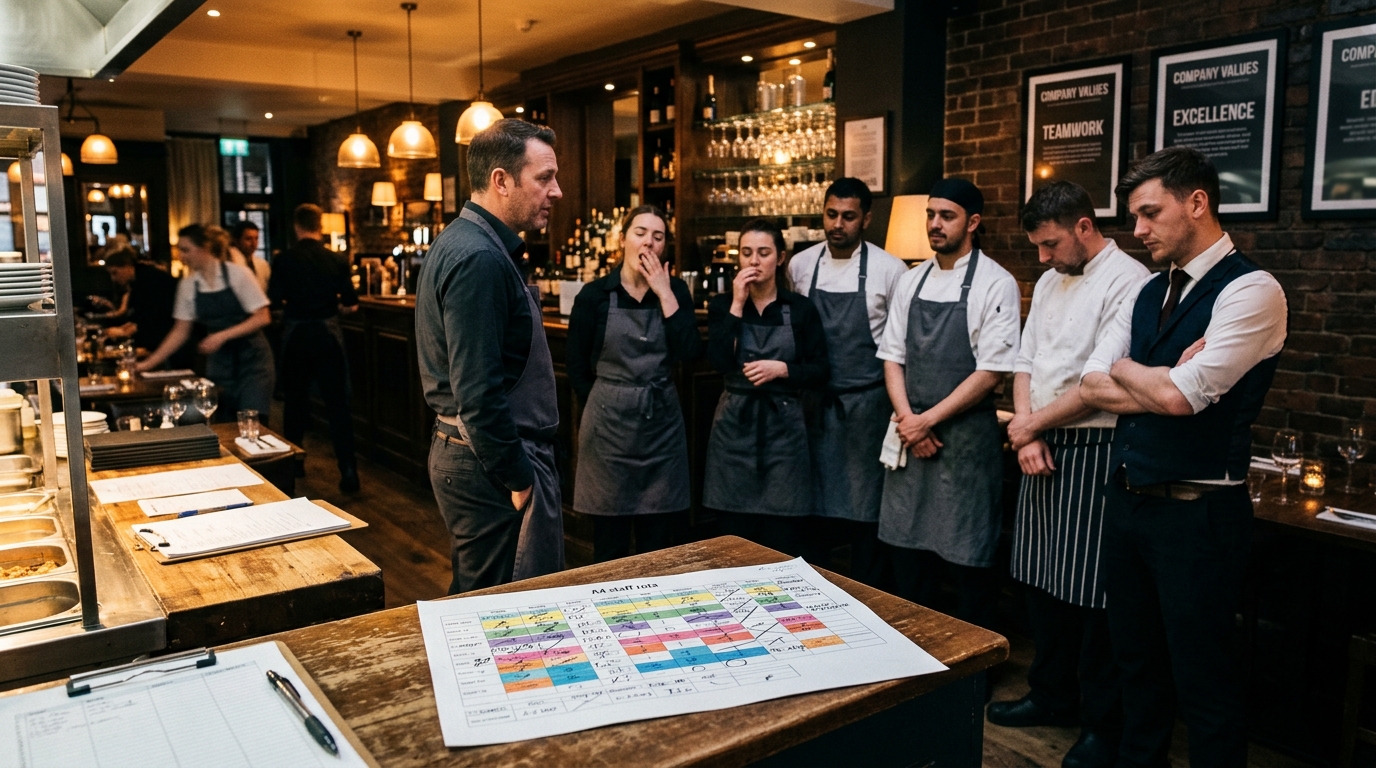
Your company values probably aren't meaningless.
They might be thoughtful, specific and genuinely believed by the people who wrote them. Perhaps they came out of two days in an off-site meeting room, survived seventeen rounds of wording changes and now sit beautifully underneath the logo in every induction deck.
People first.
One team.
Own it.
Be brilliant.
Make someone's day.
Then the new bartender finishes at 1am on Saturday, gets home at 2:15, and is back travelling to work before lunch on Sunday.
The supervisor who always helps out has somehow ended up closing every weekend this month.
A waitress who normally relies on thirty hours gets sixteen after a soft sales forecast.
The team is told to create memorable guest experiences, but Friday is staffed so tightly that the manager spends the evening carrying plates and everyone else is simply trying to survive their section.
This is where company values encounter an inconvenient problem.
Employees experience the decisions a business makes far more often than the words it uses to describe itself.
And few decisions touch hospitality employees as regularly, personally and visibly as the rota.
A rota allocates income, workload, recovery, opportunity, weekends, responsibility and time. It decides who works with whom, who gets developed, who gets trusted and who repeatedly carries the difficult shifts. It also determines whether the team has enough capacity to provide the standard of hospitality the company claims to believe in.
If those decisions repeatedly contradict the values on the wall, the values don't necessarily become false.
They simply stop being believed.
Your rota is probably the most honest culture document in the business
Daniel Coyle spends much of The Culture Code examining why certain groups develop extraordinary cohesion while others don't. His framework centres on three recurring skills: building safety, sharing vulnerability and establishing purpose. He describes culture as something created through repeated signals and behaviours, rather than something an organisation simply possesses.
That idea translates almost uncomfortably well to hospitality rotas.
Take safety.
In a scheduling context, safety is partly physical, but employees also read other signals. Can I roughly predict what I'll earn next month? If I tell my manager that four closes in a row are exhausting me, will that be heard or held against me? If I become the dependable person, will the business look after me or simply discover how much more work I can absorb?
Then vulnerability. Can a manager admit that they've written a poor rota and change it? Can a chef say the kitchen is too thin for Friday without being accused of protecting labour? Can a bartender tell you they need a weekend off before reaching the point where they simply call in sick?
Finally, purpose. A company can tell its team exactly what kind of hospitality it wants to create, but somebody still has to give that team enough time, skill and support to create it.
Coyle's work repeatedly comes back to signals. People watch what the group actually does, and those signals tell them whether they belong, whether they can speak honestly and where the organisation is really trying to go.
A company mantra is one signal.
The rota arrives every week.
Guess which one gets read more carefully.
Your values are written on the wall. Your culture is written on the rota.
Imagine a hospitality company whose first value is People First.
Sounds good.
Now look at twelve weeks of rotas.
Do the same dependable employees carry every peak? Are contracted hours reasonably stable? Do managers receive enough recovery after late finishes? Does one person's availability seem to be treated as a mild suggestion while somebody else's is sacred? When sales soften, whose hours disappear first?
You will probably learn more about how People First operates in practice from those twelve weeks than from the culture presentation.
The same test works with development.
A business says it grows its own people, yet every shift is scheduled at the minimum level required to operate. Nobody can shadow another section. Buddy shifts are the first thing removed when labour gets tight. The new supervisor receives the keys and learns by being abandoned on a Tuesday close because there was no budget for management overlap.
The value might be sincere. The resource allocation says something else.
Guest obsession works the same way. If the company wants employees to notice the little things, anticipate needs, create moments and build relationships, the operation needs enough breathing room for people to look beyond the next immediate task.
Culture starts becoming very tangible once you view it this way.
Values are intentions.
Rotas are resource allocation.
Eventually, employees judge the first by watching the second.
Exceptional hospitality needs spare human attention
This is where Will Guidara's Unreasonable Hospitality becomes particularly interesting.
The memorable stories are famously extravagant, but the deeper principle isn't really about sledding trips, surprise gifts or increasingly imaginative ways to delight somebody. Guidara's hospitality-first philosophy depended on people being empowered to notice guests, exercise judgement and act on what they saw. His publisher describes the culture as extending to the team itself, including empowering employees throughout the organisation to think with ownership. His newer Field Guide goes further into the systems that sustain hospitality culture, including excellence, communication, collaboration, feedback and repair.
There is an operational prerequisite hiding underneath all of that.
You need enough human capacity for somebody to notice.
Picture the opposite environment.
The host has twenty people waiting at the door.
Every floor section is stretched.
Drinks are running fifteen minutes behind.
The manager is polishing cutlery because there is nobody else available.
Kitchen is buried.
Somewhere on table 34 is a guest celebrating something important, telling a story that could have given an attentive employee the opportunity to create one of those extraordinary hospitality moments we all love reading about.
Nobody hears it.
Everyone is too busy.
This isn't a criticism of the team. They are prioritising correctly in the circumstances. When an operation reaches capacity, human attention narrows to whatever is most urgent.
Get the drinks out.
Clear the table.
Answer the ticket.
Fix the complaint.
Find some glasses.
Survive until close.
You cannot repeatedly schedule a team at the absolute limit of its capacity and then be surprised when hospitality becomes transactional.
The labour saving might be completely rational.
The cultural cost rarely appears on the wage report.
Unreasonable hospitality occasionally requires unreasonable-looking labour
There is an interesting connection here with Rory Sutherland's Alchemy.
Sutherland spends much of the book attacking our instinct to assume that the most logical-looking decision must also produce the best outcome. He argues that conventional business thinking often rewards decisions for being defensible and rational, even when human behaviour refuses to cooperate with the model. His examples deliberately celebrate ideas that look odd through a purely linear economic lens.
Scheduling contains plenty of these moments.
Paying two managers for fifteen minutes of overlap can look wasteful if the handover could theoretically happen in five.
Giving your strongest closer a Saturday off might appear irrational when you know the operation would be stronger with them there.
Keeping an additional bartender through a volatile hour can look inefficient if trade comes in exactly on forecast.
Adding a buddy shift increases labour without directly increasing that day's sales.
Protecting training time when wage percentage is high can seem almost irresponsible.
All of those decisions deserve scrutiny. There is no virtue in spending money simply to demonstrate that you care.
Yet sometimes the spreadsheet-optimal decision creates a weaker business once people, behaviour and time enter the equation.
We touched on this in Your Best Rota Should Be Slightly Wrong, where a small amount of deliberate flexibility can protect an operation from the inevitable difference between forecast and reality.
Culture has similar buffers.
A little management crossover can create a proper handover.
Training overlap tells somebody their development is worth paying for.
A protected weekend tells your strongest supervisor that competence does not mean permanent availability.
An additional person at peak may give everyone else enough headspace to interact with guests rather than simply process them.
What looks inefficient at 4pm can become extraordinarily valuable by midnight.
The rota is also one of your most powerful incentive systems
Hospitality tends to think about incentives in obvious terms.
Bonus schemes. Tronc. Employee of the month. Competitions. Promotions. Maybe somebody wins a bottle of something if they sell enough specials.
The rota distributes incentives every single week without calling them incentives at all.
It controls access to income.
It decides who gets Friday evening and who gets Monday lunch.
It influences who gets to work alongside your best managers, who gets trusted with responsibility, who gets developmental shifts and who gets the sections where they can make the most money.
It also distributes inconvenience.
Late finishes.
Early starts.
Full weekends.
Split shifts.
The dead Tuesday nobody wants.
The Sunday close after everyone else has gone home.
Employees learn the rules of your culture through how those things are allocated.
If saying yes every time the manager asks results in receiving every difficult shift, you've created an incentive to become less helpful.
If becoming brilliant at closing guarantees you will close forever, development comes with a punishment attached.
If the manager's favourites somehow receive the best weekends regardless of performance, your team has learned considerably more about advancement than your leadership programme ever intended to teach them.
We called one version of this the reliability tax in Eleven Hours’ Rest Is the Legal Minimum, Not a Welfare Strategy: strong employees gradually become the solution to every difficult rota problem until the business begins consuming the very reliability it values.
The rota teaches people how the system really works.
They adapt accordingly.
People respond to more than money, until you reduce everything to money
Dan Ariely's work adds another useful lens.
Predictably Irrational explores, among other things, the collision between social norms and market norms: the difference between relationships governed by social expectations, reciprocity and belonging, and relationships reduced more explicitly to economic exchange. Ariely's wider work also argues that workplace behaviour and motivation are shaped by forces beyond straightforward financial incentives, including meaning, expectations and social context.
Hospitality businesses straddle those worlds constantly.
We tell people:
We're a family.
We've got each other's backs.
Take pride in this place.
Go the extra mile.
Treat it like it's yours.
Those are social appeals. They ask for commitment, identity and generosity beyond the narrow wording of an employment contract.
Then the same employee can experience their relationship with the company through a brutally transactional rota.
Sales are down, so your hours are gone.
You always help us out, so you're working Sunday again.
We need everyone to go above and beyond tonight, although we removed two people from the shift yesterday to protect wage percentage.
You can understand why the social language starts losing some of its power.
Culture cannot survive indefinitely on one side of the relationship.
If a business wants people to give discretionary effort, employees need repeated evidence that the organisation sees them as more than a variable labour cost.
This doesn't mean guaranteeing everyone unlimited hours or protecting every preferred shift regardless of commercial reality. Hospitality businesses have budgets, demand changes and sometimes rotas genuinely need cutting.
It means recognising the contradiction when companies ask employees to behave socially while managing them exclusively through market logic.
Eventually, people respond to the relationship you've actually created.
Hourly pay is only half the income story
The rota becomes even more culturally significant in hourly paid teams.
Imagine two businesses both paying £13.50 an hour.
At the first, an employee usually works around thirty-two hours. Their schedule is published with reasonable notice, changes are discussed, and while individual weeks move around, income is broadly predictable.
At the second, the hourly rate is identical but weekly hours bounce between sixteen and thirty-five depending on forecast. Shifts move regularly and people discover on Thursday that the weekend has changed.
On paper, both businesses pay £13.50.
The lived employment proposition is completely different.
Someone cannot pay rent with an hourly rate. They pay it with total income.
This becomes particularly important as hospitality wrestles with cost pressure. In April 2026, an industry survey published by UKHospitality and partner bodies found that 64% of respondents expected to cut jobs as a direct consequence of that month's cost increases, while 42% expected to reduce trading hours.
Those pressures are real. Labour is one of the largest controllable costs in hospitality, and pretending otherwise would make for a very short-lived business.
But the rota is where those financial pressures eventually reach a person.
A five percent reduction in weekly labour may be an abstract management decision at the group level. At site level, it becomes fewer shifts, thinner services, less training, more workload. At a personal level, it could mean somebody's expected income disappearing overnight.
This is where strong operators earn their money.
They still control labour, but they understand what each reduction actually changes.
We explored the commercial side of that in Cutting Labour Is Not the Same as Controlling Labour. The cultural consequence deserves equal attention.
Culture is what survives the P&L meeting
Most company values look excellent when everything is going well.
Trade is strong. Recruitment is healthy. The wage target is under control.
Everyone gets the hours they want and there's enough management coverage to spend time developing people properly.
Culture becomes more revealing when the forecast for next week drops ten percent. Now what happens?
Does People First still influence the decision, or does the conversation become exclusively about hours to reduce?
Does Develop Our Own survive, or does wine training get cancelled?
Does Guest Obsessed still mean anything if the proposed saving leaves the bar incapable of providing the service standard we talk about during inductions?
The answer doesn't always have to be “keep the labour”.
Sometimes the business genuinely cannot afford it.
A credible culture allows difficult decisions. In fact, one of Coyle's points is that strong cultures are capable of sharing uncomfortable truths rather than pretending problems don't exist.
The difference sits in how the decision is made and what gets protected.
A manager might remove twenty hours while deliberately preserving a new server's training buddy overlap.
Another might reduce from the kitchen on the quietest part of Tuesday instead of automatically cutting from every department.
Perhaps Saturday genuinely needs cutting, but the manager spreads the impact rather than uprooting one person's entire livelihood for the week.
Maybe the wage percentage misses target because cutting further would damage service more than the saving justifies, and somebody is prepared to explain that decision upwards.
Culture is what survives the P&L meeting.
Everything beforehand is aspiration.
Culture debt behaves a lot like financial debt
One difficult rota won't destroy a strong team.
Hospitality people understand compromise remarkably well. Somebody gets sick. Christmas is brutal. A huge event lands. For a week or two, everyone pulls together and gets the job done.
Good cultures can actually become stronger through those moments.
Problems appear when the exceptional circumstances and compromises become normal.
The same people keep sacrificing weekends. Development keeps getting postponed until next month. Managers stop taking breaks. Hours become increasingly unpredictable. Every conversation with ops is about finding another small efficiency, all while nobody notices that the team has gradually become less willing to give anything back.
Think of that as culture debt.
The business has borrowed goodwill to solve today's operational problem.
At first, the repayments are almost invisible. Someone stops volunteering for extra shifts. Another person becomes less flexible with availability. A previously enthusiastic supervisor does exactly what their job description requires and nothing more.
Then recruitment becomes harder because your best employees are no longer recommending friends.
'Sickness' increases.
Standards drop.
People leave.
Suddenly leadership wants to know why engagement has fallen.
Culture debt will never arrive with an invoice. It will turn up elsewhere in the business right under your nose.
What should your rota show if your values are real?
There is a simple test hospitality businesses could apply.
Take your company values and temporarily ignore the wording.
Ask what somebody should be able to see in the rota if each value genuinely influences decisions.
| If you say you value... | Your rota should probably show... |
|---|---|
| People | Reasonable recovery between shifts, predictable enough hours, and some protection from repeatedly carrying the worst shifts |
| Development | Training time, buddy shifts, management overlap and opportunities to stretch |
| Teamwork | Workloads that allow people to help each other rather than permanently protect their own section |
| Guest experience | Enough skill and capacity during peak for employees to notice guests rather than simply process demand |
| Empowerment | Managers with enough space to lead, make decisions and coach rather than spend every service plugging rota gaps |
| Fairness | Transparent distribution of hours, weekends, opportunities and undesirable shifts over time |
| Excellence | Experienced people positioned where standards are hardest to maintain, with enough support around them |
None of these rows requires a bloated schedule.
They require deliberate choices.
You can run tight labour and still rotate difficult weekends.
You can protect a training hour while removing two genuinely unnecessary hours elsewhere.
You can staff leanly while ensuring your strongest bartender isn't also expected to compensate for three inexperienced people at peak.
This is where A Legal Rota Can Still Be a Bad Rota becomes a much wider leadership issue. Compliance sets important boundaries, but it cannot tell you whether the schedule reflects the kind of employer you claim to be.
A good rota cannot rescue a toxic culture
There is a limit to this argument, and pretending otherwise would give scheduling far too much credit.
If pay is fundamentally uncompetitive, a beautifully fair rota doesn't change the hourly rate.
If managers behave terribly, carefully rotated weekends won't repair the relationship.
If leadership treats employees as disposable whenever numbers get difficult, software isn't going to manufacture trust.
Culture is bigger than scheduling.
But for hospitality employees, the rota is one of the places where that bigger culture becomes tangible.
It tells them when they will work, how much they might earn, who they'll spend the shift with, when they get time off to spend with others, whether they are being developed, and how much pressure the business expects them to absorb.
That makes the rota an unusually powerful piece of cultural infrastructure.
Yet strangely, we rarely talk about it that way.
Your team doesn't experience your values. They experience their rota.
A values workshop can define the organisation you want to become.
A brilliant induction can explain it.
Managers can repeat the message in pre-shift briefs, write it into development plans and recognise examples when employees live it well.
All of that has value.
Then comes time to build the rota.
If the schedule supports those messages, something powerful happens. The words and the employee's experience begin reinforcing each other.
If it contradicts them every week, the rota will eventually win the argument.
This is where I think hospitality should become much more ambitious about scheduling. A rota deserves to be judged on cost and compliance, absolutely, but also on whether it creates the conditions for the culture the business says it wants.
Sometimes that will mean challenging an extra shift.
Sometimes it will mean defending one.
Occasionally it means asking whether the apparently irrational decision to spend another £20, protect somebody's weekend or give a manager fifteen minutes of crossover is actually buying something considerably more valuable than labour.
If you're curious how closely your own rota process matches the kind of operation you think you're running, our free Rota Reality Check looks beyond individual shifts at the wider system around them: people, workload, deployment, margin, rework and the decisions that shape the week.
Company values don't become culture when somebody writes them down.
They become culture when people repeatedly experience them.
And every single week, the rota is the polling booth where the team gets to vote on it.
Values are what the company says they are. The rota is where the team decides whether to believe you.